Showing posts with label classics. Show all posts

Wednesday, January 16, 2008

Ask The Dust by John Fante

One night I was sitting on the bed in my hotel room on Bunker Hill, down in
the very middle of Los Angeles. It was an important night in my life,
because I had to make a decision about the hotel. Either I paid up or I
got out: that was what the note said, the note the landlady had put under my
door. A great problem, deserving acute attention. I solved it by
turning out the lights and going to bed.”

So reads the first paragraph of John Fante’s novel Ask the Dust. When I first read this in the preface of Brett Easton Ellis’s The Informers, I was immediately drawn to the simplicity, the frankness, and the desperate nonchalance that even a few sentences brought out. So I said to myself, “Who is this John Fante, and where can I get a hold of his book Ask the Dust? It wasn’t anywhere. I couldn’t even buy it locally.

Eventually, I found a copy and read it. It was written in first person. The situations were real. There was both a human and animal element to it. The story was about a young displaced writer in 1930’s L.A., facing poverty and unrequited love while trying to make a name for himself in a rented room. Actually, the story wasn’t necessary. You see, when I had finished reading it, I barely remembered the plot. It didn’t matter. The author had opened up the private thoughts of the human mind. He had not spared embarrassing, awkward situations, and had written about the details of life. This was what most impressed me -- that a guy could be this honest about himself, and that he could truly know himself this well to put it all down on paper.

So after that, I read everything by Fante I could get my hands on. It was more of the same. Situations more honest than before – even his domestic writing that was done in the 1950’s like Full of Life, a story about the birth of his son, had that edge. Well, come to find out that Ask the Dust was heavily influenced by another called Hunger by Knut Hamsun. I picked that up too, and started reading it. It was even more desperate, and more spiritual. I sort of felt gyped -- like Fante had simply popped himself into Hamsun’s book and taken out some of the more desperate elements. But I’m still glad he wrote it, they say he is the father of the L.A. novel, and probably one of the more underappreciated writer’s of American Literature. Fante eventually ended up making big bucks writing for the movies, and he always said it finished him as a novelist.

Fante would have pretty much been lost as a writer, had he not been rediscovered in the early 1980’s by Charles Bukowski. Bukowski had a huge following and called Fante “his god” after having discovered him the reading room of the L.A. Public Library. While Fante’s stuff is more toned down than Bukowski’s, you can still see the influence there. That wonderful raw edge of humanity.

Saturday, December 22, 2007

Babbitt by Sinclair Lewis

When the 20's were bursting out all over, we find the antithesis of the Fitzgeraldian hero, a 40 something, unoriginal humpty dumpty, but groomed sort of fellow called Babbitt. Babbitt's secret desire is to live again, not in the suburban sense, but in a wild and colorful way, and he supresses it until he finally erupts and makes a complete hind end of himself. He throws away his Boosterism, his faithful but bland wife, and converges on his quiet midwestern city of Zenith with a fervor that will rock the tabloids and fuel the gossips until the second coming. Realizing that the futility of his efforts will not free him from the dyed in the wool masses, Babbitt submits to becoming a cog in the machine and finally realizes his ambitions through his offspring in a sarcastic salute to Zenith and to the world. Hurray for all the Chicken Croquets and Lettuce Sandwiches that are consumed in this book, and a toast to Sinclair Lewis who has had entirely to many already.

Friday, May 25, 2007

Dickens World

Not a formal review but I have to say I am exceedingly excited about a new theme-attraction I heard about yesterday on NPR that opens today. It is Dickens World, that's right...an exciting journey all about the world of 19th century England centered on the works of Charles Dickens. Located in Chatham, it features Scrooge's haunted house, Fagin's Den, the dockside, streets and alleys...all the sights and smells (I don't know if I'm too enthused about smelling the dockside, I think they were still using the Thames as a sewer in Dicken's time). The Dickens World web site doesn't have too many pictures, just a time lapse streaming video of the construction site. NPR Marketplace has an inside construction view and the picture towards to bottom of the article features the London sewer boat ride (very Our Mutual Friend). So the next time you happen to be near England, stop by and step into another era!

Tuesday, August 22, 2006

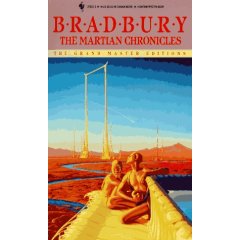
The Martian Chronicles


In honor of Ray Bradbury's birthday August 22, 1920:

The Martian Chronicles is made up of a collection of short stories written by Ray Bradbury during the 1940s along with "filler" vignettes to tie these stories together. The "novel", published in 1950, tells the future of space travel to Mars starting in 1999. The vignettes follow multiple expeditions to Mars, starting with the first expeditions to later mass colonization.
This is science fiction, speculative fiction, at its best; even if you are not a fan of science fiction, this is a very accesible book with plenty of philosophical themes thrown in.
Perhaps my favorite vignette is the one on the automatic house. This house cleans itself, prepares breakfast for the human inhabitants, and recites poetry. What the house can not realize is that the owners have been annihilated in a nuclear blast, and all that remains of them are their shadows on the outside wall.
Another favorite features Walter Gripp. Walter Gripp lived on the outskirts of a major settlement on Mars. He comes back to town to refurnish his supplies, only to find that everyone has left to return to Earth rather hastily. The streets are empty, the cash registers are full of money, and he has the whole town to himself. He's lonely as the last man on Mars, until the phone rings one day.
The short story format makes this an easy read, and a definite recommendation from me. Enjoy!